Hoppo Bumpo (n): A children's game. Played by folding one's arms and hopping on one leg. Aim is to bump opponents, so that they lose their balance. Last person standing wins.


March 31, 2009

Just a minute ... in March


I am joining in with Jenaveve's Just a minute meme, where we take a few moments to recall what we've been doing during the month. So the the best of my recollection, it went something like this ...

Growing ...

... very little. March was characterised by horticultural disappointment. The brown wilted Grosse Lisse (what a misnomer) tomato bush, gave up its last few miniature tomatoes. The wild excitement when we discovered that two watermelons had set on the long curly vines, was soon replaced with disinterest when a mouldy black rot set in. The lemon tree was a dud, again. The coriander (pictured above) went to seed. The lettuces shuffled off the mortal coil. I am in two minds about whether to plant winter vegetables. Though I rather suspect that the glorious autumn weather we have been having here in Melbourne, is likely to lure me back to the nursery ...

Creating

... invoices and receipts. As I may have mentioned previously, I am our kindergarten's treasurer. March is a busy time. Term fees are invoiced; money collected, receipted and deposited. I sometimes have trouble believing that our kindergarten system is so poorly funded that someone like myself would be "doing the books", as a volunteer. Clearly, no-one realised that my forte is spending money, not collecting it.

When I haven't been knee deep in mail merges, databases and spreadsheets, I have been working on my first quilt (the lovely Two Square pattern from Audrey and Maude) and continuing a little work on my crocheted Afghan (granny) squares. I went wild and completed a whole two squares this last month.

Watching ...

... a new children's program called Chuggington. For the uninitiated its another English offering comprising talking trains. The boys are obsessed. Apparently I am now called Karen and Argy and Bargy are Wilson and Brewster, respectively. I was relieved to discover that Karen is a human and not a train with a massive caboose.

Reflecting ...

... as I looked at the calendar: I have now been a stay-at-home mum for four years. Next week is Argy's birthday. The time has gone in a blink of an eye, but somehow some of the memory of the pre-kids, worklife is becoming hazy. I wonder where I will be in 4 years time? Yesterday I saw a bumper sticker that said "The best way to predict the future is to help create it". I liked that.


To see who else is playing along with Just a minute ... head over to Jenaveve's blog, August Street.

March 30, 2009

The winner of 4 Ingredients


Thank you very much to everyone who entered the cookbook giveaway during this last week. I loved reading about every one of your shameful meals. I think I might have even gleaned a few useful tips!

The winner (drawn here) of the very handy 4 Ingredients is .... #11.

Congratulations to the delightful Aunt LoLo in Connecticut USA, who is partial to two-ingredient recipes such as rice and soy sauce!

Making the grade: trialling a customised pattern service (part 1)


A little while back I stumbled across the term "sewbie". It refers to a newbie sewer; a beginner. Being newish to sewing myself, I quite liked the term. Its kind of cute.

As a sewbie, my journey from stitching innocent to enthusiast, has traversed a standard sort of path.

It started with a bit of cutting and sewing and a pair of pyjama pants. Then a few button holes and a bit of easing and a matching pyjama top. Next came facings, darts and zippers and et voila there was a skirt. Then there was a period of consolidation: sewing from commercial patterns; drafting a few little projects.

All along, though, I knew I'd soon arrive at that sign-posted fork in the road. The big one, where one direction points to "Comfort Zone" (on the flat, of course) and the other to "Real Pattern Alterations" (up a steep hill).

When I did finally arrive, uncharacteristically I chose the hill. You might still see me there sometime: I'm the one puffing asthmatically and puce in the face.

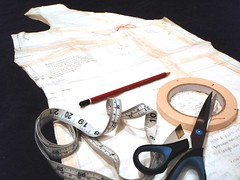
There is, however, a little endorphin rush every now and then. Its exhilarating learning how to be the master of your own sewing destiny. To make something that fits properly; looks flattering; feels comfortable. Recently there's been a flurry of grading and slashing and spreading and redrawing of seam lines on paper patterns. My sewing space is a jumble of calico, tracing paper, pencils, rulers and tape as patterns are redrafted and toiles trialled.

In the midst of my latest class experiments on Misses' tunic top Simplicity 5409 (requiring an FBA, grading on the side seams and a change to the neckline), I received an e-mail. Something that really caught my attention. It was from sewingpatterns.com announcing an innovation: the Perfect Fit Pattern. This new service allows you to input your details (measurements, posture type and photos) when purchasing selected Butterick, McCalls or Neue Mode patterns. The pattern is then altered for you within 7-working days.

"And the cost?", I hear you ask breathlessly (if you are on the same hill as me, that is).

Well, I should say that the finished pattern isn't cheap. At the time of writing its US$24.50 (AU$36.10) for a downloadable version or US$27.50 (AU$40.53) for a paper pattern. This is at least US$10 (AU$14.75) more expensive than a standard paper pattern. However, if you consider the additional cost is really for a service - which I am assuming involves human intervention - it seems relatively inexpensive.

So it all sounds pretty nifty, huh?

At least, I think.

I can't help but wonder whether this will be a little bit like introducing the calculator into schools. (Call me old-fashioned, but does anyone really remember how to do long division, when it counts?). Can a remote pattern alteration service really dispense with the need to make your own changes? Will it be possible to sew lovely fitted clothes without ever knowing the theory or practice of pattern alterations?

I have decided to see.

In the name of "research" I have just purchased McCalls pattern 5758. Its a semi-fitted, hip-length jacket with princess seams. And I'd never have a shadow of a hope of making this jacket without alteration. Substantial alteration.

My measurements between shoulder and hip, includes 4 separate sizes and a bust-line that is 2 cup sizes above a standard, commercial pattern. Without going into inappropriate levels of detail, pregnancy, two gi-normous babies and c-sections, have not been at all kind to my shape. The words tummy and tuck were once uttered in the same breath by my very sensible and conservative obstetrician. (Whilst I sound somewhat grotesque, the reality is that I probably look quite similar to many other slightly overweight 5'4" mums!)

Now if all that doesn't all spell trouble for fit, I really don't know what does.

Anyway, I feel that with my dimensions, I am able to throw down a suitable gauntlet for sewingpatterns.com. Stay tuned - I'll look forward to telling you in up-coming posts about how I have found the service and showing you how well the end garment fits.

March 29, 2009

Eye spy ... a discovery


I am playing along with Cindy's Eye Spy meme each Sunday. This week Meagan of The Byron Life asked us to spy a discovery.

Mine is not so much a discovery, as a rediscovery.

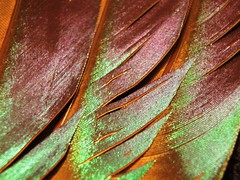
It was buried at the bottom of a container of treasures in our box room. The lightest of bags, sandwiched between a tattered stamp album and a swathe of vintage swap cards. My childhood feather collection.


Each downy and contoured addition special in its own way. A glint of colour here or a pattern there. All genuine finds from the wild. Except, that is, for one that looks suspiciously like a stray from a feather duster.

Thank you to Cindy for hosting Eye Spy and to Meagan for the fun theme. To see some more discoveries, head over here.

March 27, 2009

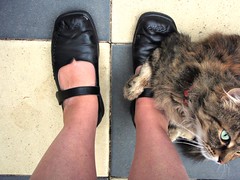
Outwardly respectable


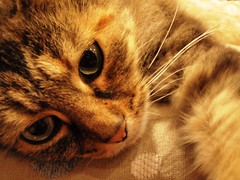
Macavity, Macavity, there's no one like Macavity,
For he's a fiend in feline shape, a monster of depravity.

from: Macavity: The Mystery Cat, T.S. Eliot

March 26, 2009

My creative space


I am joining in again with Thursday's fun My Creative Space at Kootoyoo.

Left to right:
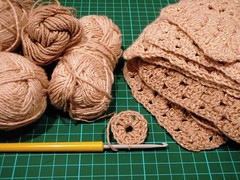
  • Wendy Pearl DK - balls of beautiful yarn (75% Mercerised Cotton, 25% Viscose) in Raffia 1804 and Bamboo 1805

  • Start of a granny square

  • Completed squares
This evening I have been taking stock of the afghan rug, that I have been crocheting since last year. Work has been completed almost exclusively during down-time spent in waiting rooms. With 176 days and 9 squares under my belt, I am averaging a square every 19.5555555556 days.

In order to be warm and toasty by winter, I need more yarn. And more appointments.

Thank you very much Kirsty for hosting My Creative Space. Its great fun seeing what everyone is doing. To see who else is showing their creative space (or to join in), head over here.

March 25, 2009

Seam along week 9 (final) - Decorative seams

Previously on seam-along ...
Introduction
Week 1 - Simple edge finishes
Week 2 - French seams
Week 3 - Bound seams
Week 4 - Flat fell seams
Week 5 - Taped (stabilised) seams
Week 6 - Overlocked seams
Week 7 - Bulky seams
Week 8 - Curves and corners

Introduction

For the final week of my work on my seam sampler, I decided to try some decorative seams: finishes that can be used to pretty-up the outside of a project. I had great fun trialling top stitching, binding and piping.

Top stitched seams

Top stitching is a visible line of stitching found on the finished side of the seam. This simple,decorative stitch line gives a nice smart finish to the seam.

To start, I tried out single top stitching using some denim. First I sewed a plain seam and then press it to one side.
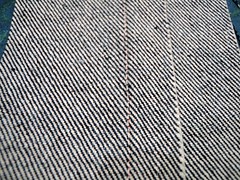


Next I threaded my machine up with a nice contrasting red thread (put your sunglasses on!).

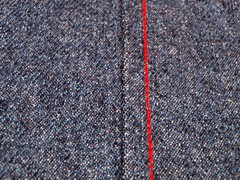
Ideally top stitch is done with a proper top stitching - or button hole twist - thread. This is a heavier weight thread that really stands out. I used Gutterman branded thread. You need only thread the spool - the bobbin can take normal weight thread.


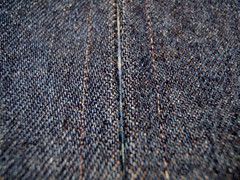
From the right side of the fabric, I then sewed a single (relatively!) straight line parallel to the seam edge. See how well the top stitch thread stands out?


For a fancier effect you can do double top stitching - two parallel lines.
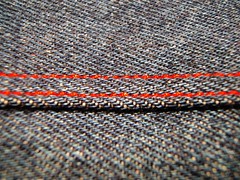


You can sew the lines separately, but the easiest way to create a double row is to use a twin needle.

If you haven't tried one of these before they are great fun. They come in a variety of types and gauges (e.g. stretch, universal, jean), as well as having varying distances between the needles.

Aside from the twin needle (shown below) you do need a second spool pin on your machine. Initially I had to hunt around on my Janome, working out what to do. Some machines have a fixed second spool pin, but on my machine the vertical second pin is a little attachment.


Once you have set up your second spool pin, you pop both reels on the machine (I cheated economised and bought just the one reel, then wound a bit of thread onto a bobbin!) and thread both up, passing the thread through the separate needles.

Note: It is possible for the two threads to get tangled and break during sewing. It can get UGLY! To minimise the chance of this happening, pass the thread down separate sides of the little tension disc near the top of the machine, when you are threading. Try also to sit the reels on the spool pin so one winds clockwise and the other, anti-clockwise.

Finally, as you sew you will see two beautiful evenly spaced lines of stitching appear. On the reverse size of the stitching, you will see a sort of zig-zag stitch that passes between the two lines. This is because you have only one thread available from the bottom (bobbin).

Bound seam

The seam is created by binding matching the wrong sides of the fabric together and then enclosing the seam in bias binding. I have tried this on a couple of bags. It works nicely where the seam doesn't need to be opened out flat and gives a clean finish to the inside of the seam.

For this finish you need a length of purchased or handmade double-fold bias binding.

In the example below, I matched the wrong sides of the denim fabric together.


Next I open one side of the bias binding out and matched its edge with the edge of the seam allowance. I then pinned it in place.
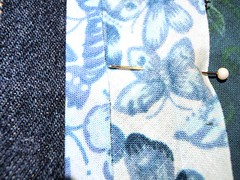


The next step was stitch all the way along the fold line on the bias binding.
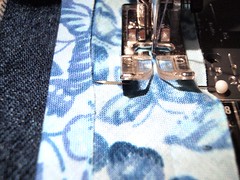


Once this was done, I carefully turn the free edge of the binding over, to enclose the the whole seam edge. Again, I pinned the binding in place.
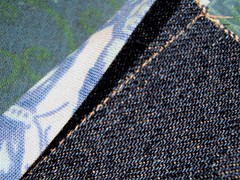


Finally I "stitched in the ditch" - that is the little dip where the denim fabric and the binding met. This caught in the binding on the reverse side.
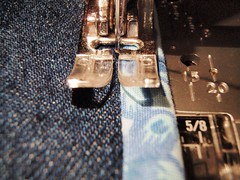


Et voila! A nice neat bias bound seam.


Piped seam

Piping is a tube of bias-cut, decorative fabric that you sew into the seam. There are two sorts: flat (just the fabric tube) and corded (where the tube wraps around a piece of cord). For my sampler, I decided to try making corded piping. You can purchase different-sized piping cord from haberdasheries.

To begin, I cut a strip of fabric on the bias. If you have a long seam and need lots of piping, you will almost certainly need to join the fabric strips end-to-end. Its a very similar process to making bias binding - see here for some photographs demonstrating how to attach the ends.

The width of the strip needs to be great enough to enclose the cord and leave a 1.5cm [⅝"] seam allowance.


Next, I enclosed a piece of cord and matched the raw edges of the fabric strip. I then pinned it to hold the cord in place.
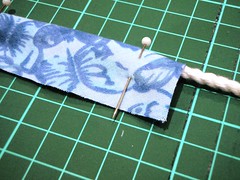


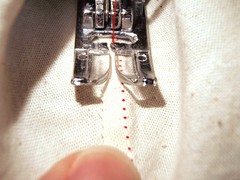
Then, I attached a zipper foot to my machine and positioned it to the left of the needle. A zipper foot allows you to sew close to the cord. (There are also special piping presser feet you can buy for different machines).

A word of warning ... in my excitement/naivety I sewed a little bit too close in to the cord! See how close the needle is? Whew - I sewed up that cord within an inch of its life!!

The wise sewer would leave a wee gap, so that one additional row of stitching can be added between this stitch line and the cord, when sewing the actual seam later.
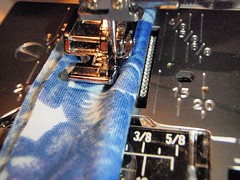


Finally I sandwiched the piping between the fabric, with the right sides of the denim together. The cord faced away from the seam allowance. Then I stitched the seam.
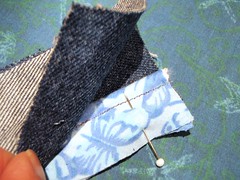


After turning the seam right-side out, the pretty, rounded piping is visible.


Channel seam

This is a very cute seam - certainly something a little bit different. I chanced upon it this week while reading through a reference book. Its classified as a top-stitched seam, but has an interesting twist.

To begin, I machine basted a plain seam (using nice long stitches), then pressed the seam allowance open.
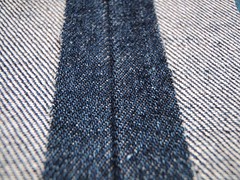


Next I cut a strip of fabric the width of the seam allowance and length of the seam. Matching the right side of the strip with the wrong side of of the seam, I pinned the strip in place. You can choose a matching or a contrasting fabric.
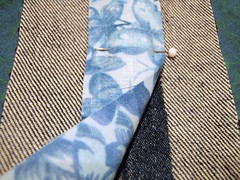


Then I flipped the fabric to the right side and top stitched through all the thicknesses, along both sides of the seam. In the picture below, you can see that I have already sewed down the right-hand side.


And finally, I carefully remove the large stitches from the machine basting, using my seam ripper. This opens up the "channel".


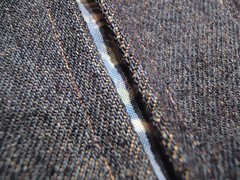
Here is the finished channel seam.


Peek-a-boo!


Conclusion

I will definitely use all these decorative finishes again. They are all quite straight forward, though I would like a little more practice with piping, to make sure I get the stitching in just the right place. The channel seam was a definite favourite, so now I am on the look-out for the right project to use it with.

Do you have other decorative seam finishes that you like using?


Next week: This is the conclusion of the seam-along. I've had great fun putting my sampler together - I hope its been useful to you too. I am on a roll now, so next week I will be starting a hem sampler. Stay tuned for details of the types of machine and hand sewn hems that I will look at. If you would like to hem-along with me, you are most welcome! Update: Hem-related articles can be found over here.

March 24, 2009

Caught out on a technicality


OK, you're right.


The wording was "don't bite the hand that feeds you"

March 23, 2009

Giving-up and giving-away


Have you ever had a serious cooking slump? You know, the point where you have suddenly run out of ideas and motivation? And you start having thoughts like ... if I have to cook another meal I think my head might explode?

I realised I had hit such a point last week. I wasn't feeling well and Mr HB had taken the domestic reigns. As I tucked into the wonderful dinner ... which I didn't have to prepare, you understand ... I voiced my appreciation. Mmmmm, what's this? I asked. Two minute noodles with a dash of soy sauce, Mr HB replied proudly.

Can you see where I'm going here? Culinary inspiration here at Chez Hoppo Bumpo, is clearly on a sharper downward trajectory than the world economy.

So its time to pull up my socks and make an effort again. To restore some simple creativity, I am going to resurrect my stand-back-and-throw recipes, next week. In celebration of giving-up suspicious, calorific, instant-meals comprising hydrolysed vegetable protein (blah!) and a long list of E-numbers, I am having a little cookbook giveaway.

I am offering a brand new copy of best-selling Australian book 4 Ingredients. This cookbook, which is a favourite of mine, has a load of easy-peasy recipes, using ... you guessed it ... 4 or less ingredients. Lovely simple dishes. And I don't think there's even the vaguest mention of two minute noodles anywhere.


To be in the running, all you need to do is leave a comment revealing the most shameful concoction you have dared to call a meal.

Anyone, anywhere may enter*. All you need to do is leave a traceable link, such as a blog or e-mail address, so I can contact you if you're the winner. I will draw the winner, at random, next Monday 30 March at 9pm (Australian Eastern Standard Time).

Well, I must be off now. There are some fish fingers that simply won't thaw themselves.


* Please note that as this is an Australian book, so it uses metric measurements and may refer to some Australian products. If you are outside of Australia, but a resourceful cook, this probably won't bother you too much.

March 22, 2009

Eye spy ... something beautiful in my backyard


I am playing along with Cindy's Eye Spy meme each Sunday. This week Monica of Beyond Pink and Blue asked us to spy something beautiful in our backyard.

Oh dear. The truth comes out now.

Dear Garden,

While I love having you, I'm afraid I am just not in love with you. And frankly its not me - its you. (Well, maybe its a little bit me, but lets move on quickly.)

Its time to be honest - you're just not making much of an effort. Summer was such a disappointment. You lazed about doing sod all: the fruit and vegies died; the flowers were decimated; the lawn was toast. You seem to have lost all interest in your appearance. And I can't say I like some of the company you are keeping. Those untidy hakeas and nasty cypresses are shady characters, who have been nothing but trouble.

Now, the final insult: you're about to embarrass me in front of my friends. I simply can't see something beautiful for looking. So I've been forced to trot out this super close-up photo of a Taraxacum Officinale and hope no-one spots its true identity.

Thanks for nothing, Garden.
Hoppo Bumpo

Thank you to Cindy for hosting Eye Spy and to Monica for the fun theme. To see some beautiful gardens, head over here.
March 21, 2009

Introducing Hoppo Bumpo Hall (or why I want everyone to be a lady)


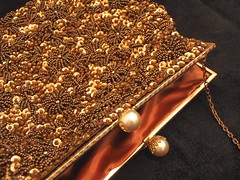
Vintage lady's purse (author's own)

I have been watching a reality series called Ladette To Lady. Its a kick-back-on-the-couch-and-gawk-in-horrid-fascination sort of show. Not everyone's cup of tea for sure. But as they say, one man's trash TV is another woman's treasure - and this one is a gem.

So if you've not had the benefit of seeing this program, here's the premise. A group of uncouth, young women are brought to Egglestone Hall, an old fashioned finishing school, to have the rough edges knocked off. The students are educated intensively in deportment, elocution, etiquette ... everything it takes to make a lady. Of course there's also the requisite amount of fancy cookery, dance, flower arranging, high teas and dinner outings ... and fraternising with foppish, B-grade aristobrats.

Each week is an elimination round, where one contestant is booted out for various transgressions, lack of progress or poor attitude .... or a combination of all of the above. There's tears, tantrums, drunkenness and the occasional flash of a bare bottom.

Sadly, its the lack of decorum -the truly disgraceful behaviour - that makes the most riveting viewing. And without a doubt the notion of a finishing school and debuting as a lady is dated; the mark of a bygone era (that is unless your family is titled and you own your own tiara). Some of the ideals are old-fashioned, perhaps even a little sexist.

But there is something I can't help but like about Egglestone Hall. No matter what is played up for the camera, there has to be some inherent good below all the sideshow hoop-la. Good manners and social graces have never gone out of fashion. There's nothing wrong with knowing which cutlery to use or how give a small speech or to do dance a few coordinated steps at a social occasion. Good posture and the ability to cook yourself a meal, also seem like handy skills. And I can't see too many visitors to this blog arguing that teaching a few craft skills, such as sewing, could be too damaging.

The bottom line is that I have found Ladette To Lady quite inspiring. This is why effective immediately, our house is to be known as Hoppo Bumpo Hall and all family members herewith are in training to be "ladies".

Now if you could excuse me, I must find my white gloves. Toodle-pip.

March 19, 2009

My creative space


I am joining in again with Thursday's lovely My Creative Space at Kootoyoo.

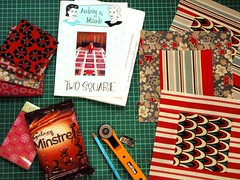
Clockwise from top left:

  • Red-themed fabric from a lovely mix pack put together by Leni & Rose

  • Audrey and Maude's beautiful Two Square quilt pattern

  • Completed blocks

  • Tools of the trade - Clover quilt pencil, rotary cutter and 1/4" machine presser foot

  • Treats from a very kind blog friend, Ellieboo
After a false start or two, I've begun work on my very first quilt.

My original plan was to make a large - very large - comfy picnic rug to use for family outings. However, I think I frightened myself off with the sheer scale of the task. Being prone to a bit of haphazard, saw-toothed cutting and crazy, swerving seams, I kept imagining the worst (despite some gentle encouragement from this talented quilter ). Honestly, just think of the size of the mess I could create with 32 fat quarters! So I never even got as far as cutting the pieces for a block.

Then last week, I saw Audrey and Maude's attractive Two Square pattern, at the show. Suddenly it made sense to start on a smaller project and find my feet. So this week, I surveyed the well-written instructions, took a deep breath, cut up some fabric and stitched bits together.

There. Done. And there lo' ... were some finished blocks. It was not half as tricky as I was expecting. Its was ... fun. So this evening I am back for more. Blocks and chocolate (Galaxy Minstrels, pictured above) - the perfect combination!

Thank you very much Kirsty for hosting My Creative Space. Its great fun seeing what everyone is doing. To see who else is showing their creative space (or to join in), head over here.
March 18, 2009

Seam along week 8 - curves and corners

Previously on seam-along ...
Introduction
Week 1 - Simple edge finishes
Week 2 - French seams
Week 3 - Bound seams
Week 4 - Flat fell seams
Week 5 - Taped (stabilised) seams
Week 6 - Overlocked seams
Week 7 - Bulky seams

Edit: Seam-along has now concluded. Click here if you would like to see all 9 weeks of posts.

To date in the seam-along, I have kept my seams strictly on the straight and narrow. This week, however, I decided to get more adventurous and see how to finish seams sewn on curves and corners.

The seam allowances on curves are shorter or longer than the stitch line, so need some assistance to sit flat. Likewise corners will not turn out to points unless you intervene.

Notching

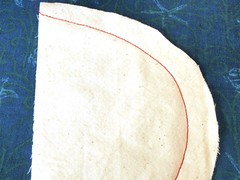
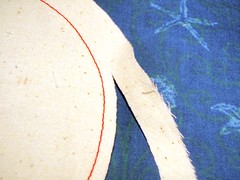
Notching is used on convex (outward) curves. I have sewn a convex seam below - you can see that the seam allowance is slightly longer than the stitch line.



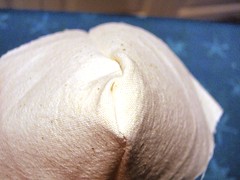
When the seam is turned you can see the effect this has on the seam allowance. Hideous! The seam allowance is too long to sit flat - instead it is bunching. This creates corresponding dimples along the right side of the seam.


To remove the bunching and create the proper rounded edge along the seam, you use a simple technique called notching. I tried this by turning the seam back to the wrong side and cutting small wedges out of the allowance. I used nice sharp scissors and being the klutz I am, made sure I kept well away from the stitch line.


After turning and pressing the seam, you can see that the allowance sits beautifully flat.


Clipping

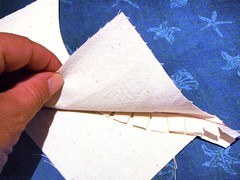
Clipping is used on concave (inward) curves. I have sewn a concave seam below - you can see that the seam allowance is slightly shorter than the stitch line.


My attempts to turn the seam right-side-out were almost completely futile - the short allowance to stitch line ratio, simply makes the whole thing too tight. In my example below you can almost hear the seam going B-O-I-N-G as it tries to flip back inward!


To fix this problem, you need to create more room in the seam allowance. This allows it to spread and sit flat. The technique you use is called "clipping". I tried this by turning the seam back to the wrong side and cutting small slits into the allowance. Once again I used nice sharp scissors and took care not to cut into the stitch line.


After turning and pressing the seam, the result is a nice curve ...


... with a seam allowance that sits flat.


Trimming

Another technique you can use on both convex and concave curves is trimming. This helps bring the the length of the seam allowance more into alignment with the stitch line. It can also help preserve some of the integrity of the seam. Clipping, for example, does relax a seam quite dramatically and in some cases you may not want this effect.

(For a very good explanation of when to use trimming rather than clipping and notching in garment making, see the March 2009 edition of Sewing with Australian Stitches vol. 17 no. 1. )

In my example below, I have trimmed the seam allowance. Generally you would reduce the allowance back to about half, but where the curve is tighter you might trim further.

Optional: The allowance could now be finished with one of the finishes that has been discussed in previous weeks. I haven't finished the seam allowance in this example, but a Hong Kong finish would have looked rather nice!


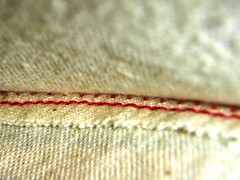
Optional: Next, in the picture below, you can see that I turned the seam to one side (the left) and stitched close to the left of the original seam line. This is called understitching and is a little bit tricky on a curve.

Why did I do this you ask? Well, it seemed like a good idea at the time. The Stitches article mentioned it and I thought I would give it a go! You don't have to do this, but it is a useful technique when you are making a garment. It keeps the seam allowance neatly in place and stops a curvy seam from rolling outwards. (Examples of curvy seams include necklines, armholes and waistbands). You turn the seam allowance and stitch towards the inner side of the garment.


The overall result is that the trimmed seam allowance sits nice flat (especially with that understitching) ...


... and a seam edge that has a nice clean curve. Beautiful! (Er ... well, as beautiful as a bit of curvy calico can be, that is).


Corners

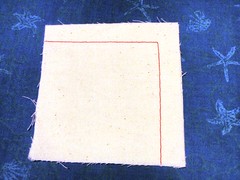
My final experiment this week was with a seam sewn around a corner.


When the seam is turned right side out, it is almost impossible to get a nice point at the corner.


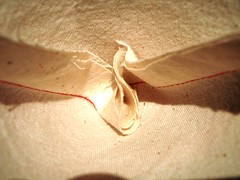
When we look back at the wrong side, it is easy to see why. Look at all that bunched up seam allowance, jostling for real estate in the corner!


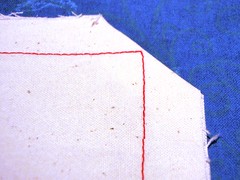
To remedy this, I turned the seam back to the wrong side and removed some bulk by clipping off the point at the corner. Again I needed to very careful not cut through the stitching! For a more acute angle, you can trim away some of the seam allowance on both sides to taper it in towards the corner.


When the seam is turned and pressed there is a nice clean corner.


Conclusion

I think I would be more likely to use trimming for curves on garments, now that I know this works so well. If your fabric frays the allowance can then be finished with binding or an overedge stitch. Clipping and notching would work well where the seam is not exposed and inclined to fray.

What do you think? Clipping/notching or trimming? What do you do?


Next Wednesday: The series final - ta-dahhh! I will be looking at some decorative seams - including piping - just for fun.